How Ulaa Protects Against Compromised Digital Certificates
Every secure website connection relies on trust. When a browser connects to a website, it doesn't just encrypt the communication. It also verifies whether the website is who it claims to be. Digital certificates make this verification possible. But what happens when the certificates themselves can no longer be trusted? A recently disclosed security incident involving eMudhra, a Certificate Authority (CA), has raised precisely this concern.
 Ulaa users are protected against the affected certificates, with no manual updates or additional action required.
What happened with eMudhra?
On October 17, 2026, a security researcher reported that a flaw in eMudhra's key generation process had produced weak private keys for eight intermediate CA certificates. These keys were generated with insufficient cryptographic randomness, making them trivially recoverable from the publicly available certificates.
These certificates form part of the infrastructure used to establish digital trust. Six of the affected intermediate certificates were authorized for TLS certificate issuance, while the remaining two were intended for code signing.
The weakness meant that attackers could potentially recover the associated private keys and use them to issue fraudulent certificates. In practical terms, this could allow attackers to impersonate legitimate websites or intercept encrypted communications on systems that continued to trust the affected certificate authorities. The disclosure identified a serious potential security risk, although it did not establish that attackers had successfully exploited the compromised keys in real-world attacks.
Why does this matter for browsers?
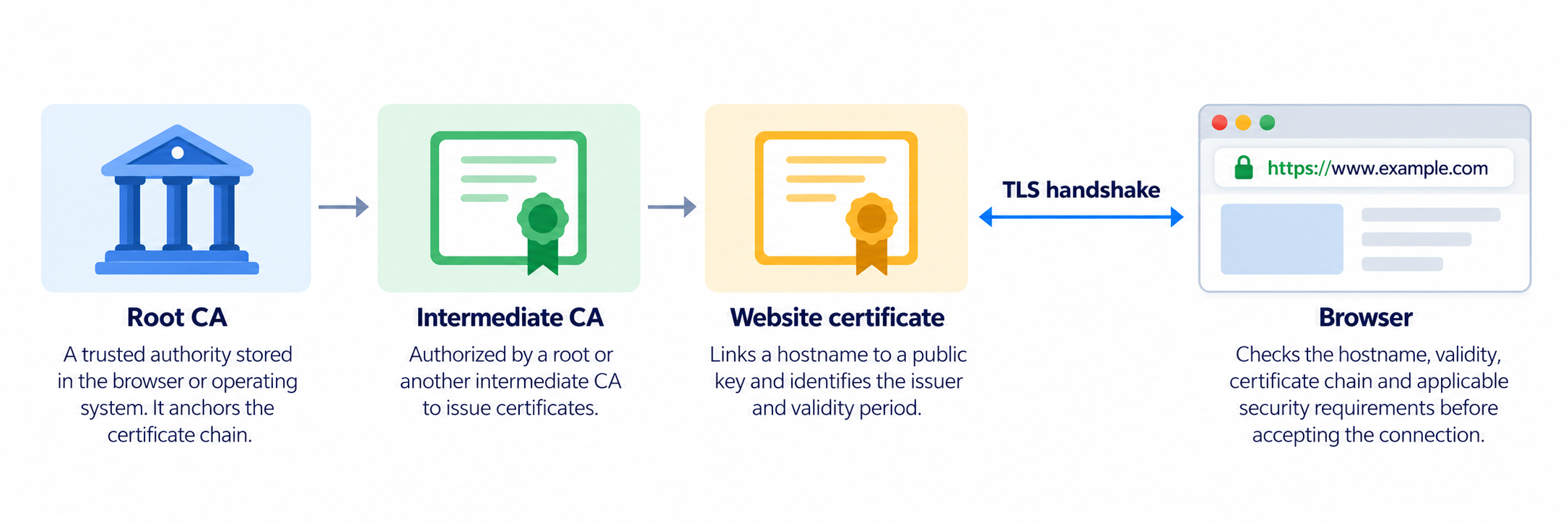
A browser's security depends partly on its ability to distinguish legitimate websites from fraudulent ones. When a website presents a digital certificate, the browser checks its validity and the chain of authorities that issued it. If that chain leads to an authority the browser trusts, the certificate may be accepted, provided the other validation requirements are met.
But if an issuing authority's private key is compromised, that trust can be abused. This is why responding to certificate-related security incidents is important. Encryption alone cannot establish a trustworthy connection if the identity behind the certificate is questionable.
How was the incident addressed?
On Saturday, October 17, 2026, at 18:05 UTC, the Chrome Root Program received the researcher's report identifying the compromised eMudhra intermediate CA private keys. Following verification of the findings, Chrome introduced an emergency Certificate Revocation List Set (CRLSet) update at 19:45 UTC on the same day. The update blocked the Subject Public Key Info (SPKI) hashes associated with the six affected TLS-issuing intermediate CAs.
By blocking the public keys rather than individual certificates, the update covered certificates sharing the compromised keys, including those cross-signed by other certificate authorities. This allowed Chrome to address the risk without requiring users to install a browser update or restart their browsers. The response extended beyond browser-level protection. On October 18, eMudhra revoked the eight affected intermediate certificates.
The incident was publicly detailed on October 20, with browser vendors and certificate trust-store operators continuing to coordinate protective measures across the broader internet ecosystem. As an additional precaution, Google announced the removal of the emSign ECC Root CA - G3 certificate from the Chrome Root Store. The change is expected to reach devices relying on the Chrome Root Store beginning October 27, 2026.
How Ulaa Addresses this risk?
Ulaa's Chromium foundation provides access to established browser security mechanisms designed to verify website identities and evaluate certificate trust.
When a website attempts to establish a secure HTTPS connection, certificate validation helps determine whether the presented certificate can be trusted. This includes checking the certificate chain against recognized authorities and applicable security restrictions. Following the eMudhra disclosure, the affected TLS-issuing intermediate CAs are blocked in Ulaa.
What does this mean in practice?
Protection against the compromised intermediates: Ulaa rejects certificate chains that rely on the affected TLS-issuing CAs, helping prevent their use in fraudulent HTTPS connections.
Automatic protection: The relevant certificate restrictions are applied without requiring users to change browser settings.
No manual update required: Ulaa users do not need to install a browser update specifically to address this incident.
No additional action needed: Users can continue browsing with the affected certificate authorities blocked.
These measures help ensure that certificates relying on the compromised intermediates are not treated as trustworthy, even if an attacker attempts to misuse the associated private keys.
Security starts with knowing what to trust
The eMudhra incident highlights an important aspect of browser security: trust is not permanent. Even established security infrastructure requires continuous scrutiny, and that trust must be withdrawn when its foundations are compromised.
At Ulaa, protecting browsing activity includes responding to emerging threats that affect the mechanisms used to establish secure connections. By building on Chromium's security architecture and maintaining protections against compromised certificates, Ulaa continues to support a more secure browsing experience.
We will continue monitoring developments related to this incident and assessing any additional measures needed to maintain the integrity of secure browsing.